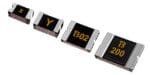
Above, we introduced the high-current withstand capability of resettable fuses and its relationship to the maximum current (Imax). Now, let’s take a closer look at the factors that influence a resettable fuse’s high-current withstand capability:
I. Design Parameters
Holding Current (Ihold): This is the maximum current at which a PPTC resettable fuse maintains its low resistance state at a specified ambient temperature (e.g., 25°C). This parameter limits the maximum current the fuse can withstand during normal operation.
Maximum Current (Imax): This is the maximum current a PPTC resettable fuse can withstand within its operating temperature range. This is the maximum current the fuse can withstand for a long period of time; exceeding this value may cause the fuse to fail.
Tripping Current (Itrip): This is the operating current, the current at which the fuse begins to trip when a certain current is reached. This parameter also affects the fuse’s high-current withstand capability.
II. Materials and Environmental Factors
Material Properties: The fuse’s material composition, particularly the properties of the polymer matrix and conductive particles, determines its sensitivity to temperature and current, as well as its response speed. For example, some materials have low melting temperatures and are sensitive to ambient temperature, resulting in a significant reduction in current.
Ambient Temperature: PPTC resettable fuses are sensitive to ambient temperature and heat dissipation conditions. In high-temperature environments, their resistance may decrease, causing their protective function to fail. Therefore, the holding current value of the PPTC resettable fuse needs to be derated at relatively high ambient temperatures.
III. Manufacturing and Packaging
Manufacturing Quality: Defects during the production process, such as material unevenness and structural defects, may affect the fuse’s performance and high-current capability.
Packaging: The packaging type of the resettable fuse (such as plug-in packaging or surface-mount packaging) may affect its heat dissipation performance and current handling capacity.
IV. Operation and Maintenance
Circuit Design: The rationality of the circuit design also affects the fuse’s ability to withstand high currents. Improper circuit design may cause the fuse to withstand excessive currents under normal operating conditions.
Aging and Maintenance: Over time, PPTC resettable fuses may experience material degradation, performance degradation, and ultimately failure. Therefore, regular inspection and maintenance are essential to maintain fuse performance.
In summary, a resettable fuse’s high-current capability is influenced by many factors, including design parameters, materials and environmental factors, manufacturing and packaging, and operation and maintenance. These factors must be comprehensively considered when selecting and using a resettable fuse to ensure optimal protection in practical applications. We recommend consulting the professional team at Shenzhen LUTE Technology Co., Ltd. We will provide customized fuse selection recommendations based on your needs, ensuring the most effective protection for your circuits.
Newsletter Updates
Enter your email address below and subscribe to our newsletter